Thursday, April 14, 2016

WWII German Wehrmacht unit designations and abbreviations- a basic primer for reenactment

     WWII German unit designations can be hard for reenactors and reenactment units to fully understand. They are very different from the American military designations that many are familiar with. They are in a foreign language, and many references use English translations instead of the original German terms. Many different abbreviations were sometimes used for the same term, making it challenging to identify which form is most common or typical. It is possible to be an experienced reenactor and amateur historian and still not really have a grip on the correct designation of the unit one is portraying. To that end, I hope that this basic primer will be of some use. 
    Why is this important? Nearly every reenactment group uses a military unit designation to identify itself. This designation is part of the "brand" of a reenactment unit. Facebook pages and web sites will bear these designations, as will camp or barracks signage at reenactment events. An incorrectly rendered designation not only can be embarrassing to a unit trying its best, but it is an authenticity issue, as well.
     The good news is that identifying the correct unit designation, and abbreviating it correctly, is not terribly difficult. The Wehrmacht was a force of millions of men, in thousands and thousands of different units, so possible unit designations and abbreviations are nearly infinite. But nearly all reenactment groups portray the same types of units (largely ground combat units, mostly Heer and Waffen-SS) and the designations for these typical units are easy to identify and describe.
     Let's start at the beginning, at the most basic level. One soldier. In most units, he is in a squad- a Gruppe. Squads are grouped usually into a platoon- a Zug. These are generally really not important from a unit designation perspective. The next level, though, is important. A number of platoons would form a Kompanie (in Artillerie units, a Batterie; in Kavellerie units, a Schwadron). The Kompanie is extremely important for the reenactor. In nearly all units, this Kompanie designation would be in every soldier's Soldbuch, the identity document every soldier carried. The soldier would know what Kompanie he was in. The Kompanie is designated by an Arabic numeral, for example: 3. Kompanie, abbreviated 3. Kp. 
    The Kompanien (plural of Kompanie) would be grouped into a Bataillon. This is designated by a Roman numeral: I. Bataillon, abbreviated I. Btl. For nearly all unit designations, the Bataillon designation is not only unnecessary, but altogether superfluous and would not be used. The reason for this is that the Kompanien were numbered sequentially in a Regiment and assigned in a regular way to a Bataillon. In a regular Infanterie-Regiment, generally speaking, 1.-4. Kp. would be I. Bataillon, 5.-8. Kp. would be II. Bataillon, 9.-12. Kp. would be III. Bataillon. So if you are in 1. Kompanie you would never need to indicate that you were in I. Bataillon because 1. Kp. is always in I. Btl. and there is no 1. Kp. in any other Bataillon in the Regiment. In general, the only time Bataillon needs to be included in a unit designation is when the unit being portrayed is a Bataillon staff. Reenactors get this wrong very often. 
      With Bataillon being superfluous, the next thing that is important after Kompanie is the designation of the Regiment, Abteilung, or, sometimes, independent Bataillon (depending on unit type). This is usually a numbered unit and the number comes after the unit type: always Artillerie-Regiment 3 or Pionier-Bataillon 3, never 3. Artillerie-Regiment or 3. Pionier-Bataillon. This part of the designation is crucial. It is most important. This part of the designation is, in virtually all cases, what determines what unit insignia a reenactor wears. The Waffenfarbe branch color worn on insignia is determined by the Regiment or Abteilung. Before the use of unit numbers on insignia was abolished, the number of the Regiment or Abteilung is what would be worn on the shoulder straps.     
     The next level up from that is the Division. This aspect of structure is of almost no importance at all unless you are portraying a Divisional staff. The reason for this is that the number of the Regiment or Abteilung is unique and only used once in the entire armed forces. There was only one Panzer-Regiment 6, for example. There would be no need to say "3. Panzer-Division, Regiment 6" because there was only one Panzer-Regiment 6 in the whole Army and it happened to be in 3. Panzer-Division. In any other Panzer-Division, each Regiment also had its own unique number, used only once. The designation of the Regiment or Abteilung makes the use of the Division designation totally superfluous. It would not be included because it didn't matter. A designation like "3. Panzer Div. Nachrichten-Abteilung" for a signals unit in a Panzer division is totally wrong. It is missing the important unique number designation (39, in this particular case) and it is including the Division which is superfluous and shouldn't be included. The correct designation for this unit is, simply: Nachrichten-Abteilung 39. The fact that it happens to be attached to a Panzer-Division, not some other kind of Division, is unimportant and has no impact on the unit designation.
     With that out of the way, we can get down to the nitty-gritty of what the unit designation looks like and how it can be abbreviated. The designation of the unit we portray is:


3. Kompanie, Sicherungs-Regiment 195 
abbreviated as: 
3. Kp., Sich.-Rgt. 195 
or more simply- and more typically:
 3./Sich. Rgt. 195

     Do you see the slash in that second abbreviation? That is something that seems to trip people up all the time. It's not the Division, not the Regiment. The number before the slash is the Kompanie, or the Bataillon. How to know which is which? Kompanie is Arabic numeral, Bataillon is Roman numeral. 3./Sich.-Rgt. 195 was one Kompanie in I./Sich.-Rgt. 195. Please note also that if you are using the abbreviation "Kp." for Kompanie, you don't also use the slash. 3. Kp./Sich.-Rgt. 195 would not be correct, even if it is not inconceivable that even some wartime Germans might have made that mistake. And don't use the slash in any other way.     That's basically it. A Kompanie in a Pionier unit might be 2./Pionier-Bataillon 22, a Schwadron in an Aufklärung unit could be 2./Aufklärungs-Abteilung 207. Note that the umlaut is a really important part of spelling, it's not Aufklarung, or Jager. If you can't type the umlaut you have to put an "e" after the vowel that is supposed to have the umlaut: Jaeger. 
     Lastly, a note about Waffen-SS designations. These will always have "SS" as part of the unit designation to differentiate from Heer units, for example, SS-Panzergrenadier-Regiment 25, or 3./SS-Flak-Abteilung 17. And as much as reenactors love the Divisional identifier worn on the cuff title, it really doesn't belong in the unit designation. Some SS units had their own special names, for example SS-Panzergrenadier-Regiment 6 "Theodor Eicke" or SS-Panzergrenadier-Regiment 3 "Deutschland." But most units did not have these names as part of the designation. A soldier in the 5. SS-Panzer-Division "Wiking" might have worn a "Wiking"cuff title if he was not in one of the units in the division with a special name, but it would not have been part of the unit designation- the Panzer unit of "Wiking" was just plain old SS-Panzer-Regiment 5. And a designation like "1. SS" simply makes no sense.

Sunday, March 27, 2016

The things one may have carried

Author: Markhard Brünner

I will begin this article by stating that I do not claim to be an expert or authority on German personal items of the second world war. I consider myself to be a guy with fairly decent attention to detail, and someone who is passionate about the material culture of the period. In this article I would like to give the reenactor a bit of a cerebral experience. Personal items are just that, personal. In this article I will share my own approach to personal kit. I invite you to comb through your things the next time you pack, and question what you are bringing, and why.

For the sake of simplicity I will restrict this article to the most common denominator- the German infantry soldier from Germany. I portray a second line infantryman. I began my service as a light towed artillery soldier whose battery was destroyed by rocket counter fire in Russia, 1942. As a disclaimer: the static nature of my impression allows more creature comforts than should be carried by a regular line infantryman. I am not going into captured items or items picked up on the battlefield. Each reenactor is the master of his own impression and may agree or disagree with my approach and conclusions.

Below is an exploded view of the contents of my trouser pockets. Among them, you will find a variety of identity documents and tags that have been issued to me, and a small field post paper chess game that has seen better days. A few Marks in pocket money, a few photos of friends from the past. Handkerchief, my pipe, tobacco pouch, a small tool for cleaning it, and a lighter.
Everything packed up in its configuration to go into my pockets. I use a handkerchief from back home, and keep the army ones with my rucksack. The army issued ones are scratchy and I don't like using them, but I will remain accountable for everything in my clothing issue.
The contents of my Feldbluse pockets. These things are items I feel important enough to have with me all the time. I have my sewing kit, some ammunition, a battery. A small flashlight that is handy for finding things in the dark, some earplugs to retain what is left of my hearing after the Russian artillery took most of it. Ointment, a comb, my knife, keys, and some writing instruments.
Rucksack contents. Everything in here is only useful to me when I am bedding down for the night or when I am need to do some maintenance/hygiene. In here you will find my hygiene kit, some bathing soap, my leather care gear, spare socks, some extra food and tobacco, my Esbit stove and some candles.
All of these items have been chosen by me to best represent a German soldier utilizing German items. There are some items that are not present. Handy civilian items that have been picked up in foreign lands are obviously a real thing, this is impression/scenario based and, if used correctly, can greatly enhance an impression. For captured/ acquired items, I focus on consumables- things that you use and throw away. Cigarettes, tobacco, matches, and food are small items that can broaden your vignette portrayal of a German soldier in foreign lands. But you can never go wrong with the German standard. 

I choose not to go overboard with carrying around food. You received your rations, you ate them, and continued with your day. Why carry around something that you could have enjoyed and not lugged around? How long will you carry that chocolate bar?

Tuesday, December 15, 2015

Public "battles" in living history


Sicherungs-Regiment 195 focuses mostly on immersion events, where we try to recreate the daily mundane life of WWII German security troops. We also attend living history events where we interact with the public. Although we are not educators, we try to share what we have learned with people interested in the time period. Participating in living history events allows other history enthusiasts to see and handle the equipment we use, and we try to craft interactions that have some educational value. For instance, a recreated field office can lead to a discussion about the importance of bureaucracy in a totalitarian regime. Further, as Sicherung troops, our under-equipped, stripped-down approach often serves as a stark counterpoint to other more sprawling displays which may offer plenty of "eye candy," but little sense of how field soldiers of the era actually lived.

 
Public battles, though, are a different story. Simply put, our unit does not participate in them. Ever. We will not perform mock battles as part of any "edutainment" scheme. It is our view that public battles can never be realistic, and that they do history a disservice by presenting a sanitized and glorified caricature of combat. Promoters who claim that the public can see what WWII looked like, by watching a public battle, are simply being dishonest. Spectators, who walk away from these spectacles believing that they have seen something realistic, have unfortunately been misled. WWII combat was not something that was suited for spectators, and can not be adapted for “edutainment” without an overwhelming vast compromise that destroys any attempt at historical integrity. The result is, at best, a clumsy cartoon; at worst, public battles put a glorious shine on mass violence and loss of life of an enormous scale. If a realistic depiction of a WWII battle could be created, any spectators would probably run away screaming, and certainly would not be offering up applause at the battle’s end. Individual members of our unit may have different personal views, and may choose to participate in public battles, with other units for their own reasons. But Sicherungs-Regiment 195 has chosen not to support public battles as a unit. Our policy is to focus on more productive, positive, realistic and educational efforts when interacting with spectators.

Wednesday, July 29, 2015

The Gruppe as Feldwach

     In our portrayal of security troops, our main activity in the field is setting up a Feldwach, a guard outpost. Generally, we guard important roads or other targets that could be subject to sabotage or attack by partisans. What follows is a translation from the German Army manual H.Dv. 130/2a, "Ausbildungsvorschrift für die Infanterie, Heft 2a: Die Schützenkompanie," from 1942. This material is intended for rifle squads in a regular Infantry unit, no doubt there were differences in how the Feldwach was set up by undermanned, underequipped security forces in the rear. But the general principles of how such outposts were to be arranged likely still applied, and we attempt to conform to these principles whenever possible, though we are limited by our lack of manpower and equipment.

The Gruppe as Feldwach

     The Feldwach when serving as a forward post is often in Gruppe strength [squad strength, 8-10 men]. It can also be formed with stronger security forces.
     The Gruppe as Feldwache helps protect resting troops from surprise or attack by the enemy.  They prevent breakthroughs of enemy scout troops. Thrusts of motorized enemy forces, especially armored forces, are defended against.
     If no other orders are given, the position must be defended.
     The Gruppe as Feldwach is always reinforced by anti-tank weapons, and often by heavy machine guns, light or heavy mortars, and/or Infantry engineers.
     They are generally equipped with flare pistols, a bicycle for a messenger, hand grenades, and armor-piercing ammunition in drum magazines.
     They can be supplied with entrenching tools, materials for obstacles, Tornister [field packs] and rations.
     At night, in weather conditions with poor visibility, in terrain that offers limited observation, and when the enemy is near, the number of Feldwachen is increased. The terrain between Feldwachen is observed by scout patrols.
     The position must be chosen so that good observation and fields of fire can be achieved. Mostly, the position lies along a road or another path.  The possibilities of movement for enemy armored forces or vehicles must be considered. Proximity to terrain obstacles or use of terrain that is unsafe for tanks is to be strived for.
     Construction of a battle-ready roadblock on the road to be secured increases possibilities for defense. This roadblock must be dominated by the fire of weapons, especially anti-tank weapons, and it must be able to be defended.
     The position, when possible, must be chosen so that it is concealed. A concealed path that leads to the securing troops makes it easier for messengers and for reinforcement in case of enemy attack.
     The Gruppe must know their task. This includes the field of fire, the location of strongpoints, and the time to open fire.
     The Gruppenführer [squad leader] sets the Gruppe up in such a way that the field of fire is controlled by their weapons. For this purpose the Gruppenführer stays with the light machine gun. He arranges the rifle positions on one or both sides of the machine gun.
     The Gruppe strongpoint is made up of multiple foxholes. They should not extend over more than 30 meters. Each foxhole is occupied by 2 or 3 riflemen.
     The foxholes are irregularly staggered, 4 to 8 meters apart depending on depth. As a further step they can be connected by shallow trenches, or connecting trenches.
     If the machine gun has the task of firing at long ranges, it should fire whenever possible from one or more alternate positions. Concealed paths between alternate positions are a prerequisite.
     If no enemy activity is expected during construction of the positions, and if time is available, ongoing reconnaissance and preparation can go ahead of the construction.
     The construction is mostly limited by camouflaging and arrangement of the position and by the construction of a battle-ready roadblock.
     For observation of terrain on which an enemy would approach, for local protection of the roadblock and of anti-tank weapons as well as for their own security, the Gruppenführer can set up one or more guard posts in strengths of 1 to 3 men, depending on situation and terrain.
     The remaining members of the Gruppe, after the position is constructed, remain battle-ready in the defensive positions. If the situation allows, they can take cover in the rear of the defensive positions.
     During the day, the guard must observe the terrain over which an enemy would approach and especially the roads leading to the enemy and the areas between them. He himself must stay out of sight of the enemy.
     Occupation of high ground is advantageous for observation and listening. At night, and in weather conditions with poor visibility, the guards mostly remain in immediate proximity to a road or other path.
     The guard is equipped with binoculars and a method for signaling, and often also with a machine pistol.
     Smoking can be permitted. It is recommended that the guard sit or lie down if possible.


Saturday, July 18, 2015

Formation of a distant outpost of Sicherungs-Regiment 195

We are honored to announce the formation of "Sicherungs Regiment 195 im Süden", another Sicherungs Regiment 195 “outpost” in the Pennsylvania area.

When we formed Sicherungs Regiment 195, we sought to break the standard mold of what it meant to be a “reenacting” unit. We do not have unit dues, we do not have any attendance policy. Going to our events does not lead to awards and rank promotions in our group, we want members to attend purely because they want to be there. Our members are free to also belong to whatever other units they may please. We are amateur historians looking to create an authentic portrayal together, that alone drives everything that we do. All we ask of our members is that they do what they can, to help achieve our goal. Our membership policy is different than that of most other reenactment units, but it mirrors, in a way, the historical reality of the type of unit that we portray.

Sicherung units, especially on the Ostfront, were often composed of small, remote, outposts separated from each other by huge swaths of land. While they may indeed have been under the same overall command structure, local conditions, local command, supply, orders, numbers, landscape, weather, needs, partisan activity, etc. could vastly fluctuate from one outpost to the next. We surmised that if any other Sicherung units were to form in the reenactment community, that we could reflect this wartime reality of remote, distant outposts within the present day. This is exactly what we are now doing, as we welcome Sicherungs Regiment 195 im Süden into our family. This “remote outpost” will be run by the local commander. He is free to command his outpost as he sees fit. We do not impose conditions on him, how the outpost is run is at the discretion of the commander and his men. However, we will all be functioning as part of the same overall unit impression. We will be sharing historical research, photos, event AARs, Feldpost, and other zoney, period-based activity with each other. All of this is done with our aim to push the hobby into new, progressive, innovative approaches. Sicherungs Regiment 195 is not one, single, reenacting unit. We hope eventually to be a collective of outposts that dot the countryside. Each post will be run according to its own local need and situation, yet all working towards the same goal: expanding the hobby well beyond powder-burn tacticals.

This approach entails some risk. Traditionally, most reenactment units have competed with each other for members or for prestige. Units zealously protect their unit identities and gnash their teeth when another unit adopts a similar portrayal. The reality, though, is that none of us own history. None of us served in the real-world military formations that we seek to recreate. We believe that a cooperative approach will pay dividends and we are open to others, in whatever region, who want to be a part of the unit impression we are crafting.

Imagine an event scenario jointly crafted by a number of outposts. At the same time, each outpost takes to the field. Each outpost plays its part in the larger scenario. Perhaps there is some limited contact between the widely separated outposts during the event. At the end, the various outposts share photos, compare what happened and begin to plan for the next joint endeavor. The combined experience helps make the next event even better. We believe that this vision could become reality, with time.

If you are in the Pennsylvania area, and are interested in becoming a part of a unique approach to living history, please contact Sicherungs Regiment 195 im Süden via this link.

Sunday, May 31, 2015

Look it, live it, love it

     Sicherungs-Regiment 195 has authenticity requirements that are very simple. The items we use must be correct to the time before 1945, period. Our members must obtain a basic soldier's kit, and we maintain a list of the uniform and equipment items that every member needs to have and also lists of items that are not permitted. Nowhere in this material do we stipulate that items must be from specific vendors only. We accept and use items from any and all sources as long as they are correct for the time. Despite the fact that our members are entirely free to choose items from whatever supplier they prefer, we would gladly put our impressions up against any group in the country when it comes to authenticity and realism. Why is that?
     There is, in this hobby, a school of thought that the one and only way to a realistic impression is through spending a fortune at glamour vendors. Although we are happy to support vendors who offer top quality products, we reject the view that only the "very best" (that is, most expensive) items should be used by anyone. Instead, we simply judge each item on its own merits. There are items from every supplier that we regard as usable. There are also items from many suppliers, including some with the most devoted fans, which we would prefer not to use.
     Making a silk purse from a sow's ear is an important skill for a reenactor. A brand-new reproduction item fresh out of the box is like a blank canvas. It has no soul. Use, wear, passion, and attitude go a long way to making almost anything look convincing. Minute details of stitching, hardware or color shade lose importance on an item that is grimy, faded, threadbare, reworked and repaired. An item that has been worked on and used hard will have a uniqueness and character that an off-the-shelf piece lacks.
     Give us an array of cheap imported gear and we will pick and choose and hit it out of the park. Offer us a choice between a "low-end" and a "high-end" item, we aren't going to be asking where each was made- we are simply going to go with what looks real. To us, $100 for a 90+ percent accurate item is (generally speaking) a far better deal for most than paying many hundreds more for something so marginally better that the quality difference can only be discerned through hands-on inspection by dedicated enthusiasts. For most reenactors, who are faced with financial contraints when assembling an impression, it is better to save the money and put it towards a German language course, or gas and event fees so that a reenactor can put his face in the place and hone his craft.
     There are people out there who regard themselves as "elite" reenactors simply because they spent the most money while building an impression. We see it differently. For us, being an elite reenactor means being extremely advanced in specialized knowledge gained through study and experience. It also means one has perfected his craft and raised it to an art form. Elite reenactors are almost always in elite reenacting groups (not to be confused with those portraying real-world elite units). Becoming an elite reenactor takes time. It's not something that can be obtained instantly by someone with the funds to purchase the costliest kit. It can't be bought. It comes down to skill, knowledge, style and guts. Hard work. Attention to detail. How you wear it is as important as what you are wearing.
     Ultimate authenticity is a phantom but that won't stop us from striving in that direction. Looking beyond the material is an important step on that road. See you out there.


Sunday, May 17, 2015

WWII German "Booby Traps"

Our impression is based on an isolated, rear area, security outpost. Essentially we are combat ineffective, and passive defense is all we have to offer. One means of soft protection is through the use of booby traps. These were commonly used by the Germans during WWII, especially when abandoning a position, in retreat, or as means of passive defense. This blog post is an introduction to WWII German booby traps. 

Introduction: A booby trap is an explosive or non-explosive device or other material, deliberately placed to cause casualties when an apparently harmless object is disturbed, or a normally safe act is executed, or a normally safe place is occupied. They are not offensive weapons, and no battle, let alone war, can be won with booby traps. They are defensive weapons. They can provide early warning of a foe’s approach. Their main contribution is psychological, and a slowing of the enemy’s advance. For non-combat reenacting purposes, setting (non-active) booby traps is a very “zoney” experience for immersion settings.

Activation: Booby traps are activated by one of a few means. These are the most common forms of bobby trap activation.

Pull Release: A basic trip wire. An explosive charge is anchored, and wire is attached to some other object. A pull on the wire releases a firing pin in the explosive. These are mostly German stick and egg grenades (activated via trip wire). 

Tension Release: When wire is cut, broken, or released

Pressure: Adding weight to an object

Pressure Release: Removing weight from an object

Lever Release: Fuse activated by pulling a safety/arming pin. An “enticing” object is placed on top of a grenade with the lever removed. The “enticing object” has just enough weight to keep the release lever in place. Once the object is moved, detonation occurs. Many Russian and Allied grenades were this style, and could be used in this fashion.

Placement: The Germans excelled at predicting enemy thought processes in order to develop unpredictable booby trap situations. One famous example involved a crooked painting on a wall. The Germans anticipated that only an anal retentive Officer would want to straighten a crooked wall hanging. They were correct. When an Allied Officer straightened the photo, movement of the picture frame activated a booby trap, and killed him. This illustrates that the key to placement is to think ahead, to anticipate how people interact with their environment, and to place traps that mesh with those actions. That said, there are some general principles that serve as guidelines to where, and how, booby traps should be placed and positioned.

Booby traps are most effective when used in small, confined, spaces. In such spaces there is a higher chance of activation, and greater explosion impact. Examples of such spaces are passages, stairways, doorways, smaller foxholes, narrow paths, etc. Items of curiosity are also great choices: souvenirs, containers, jewelry, food, water, gasoline containers, “abandoned” weapons, etc. Everyday operations can also be nefarious booby trap locations. Opening a window or door, flipping a switch, picking up a phone receiver, etc. The Germans booby trapped almost every conceivable area, and type of moveable object, with assorted prepared charges.
  
In Roadways
-Obstacles in road / near roadside (Very common. Some type of obstacle is placed in road. Log. Barrel. Vehicle. Anything. It is booby trapped to explode when moved. A field of fire can also be set up on the roadblock.)
-Embankments
-Blind bends
-Bridges
-Culverts
-Wooded stretches
-Junctions
-Crossroads
-General debris
-Shoulder of roads (sharp corners), where vehicles/foot solider may swerve off main road
-Near roadside houses or obvious turnouts, where vehicles are likely to pull over, or parking areas
-Entrance to detours
-Railroad crossings

In Open Country
-Woods
-Trees
-Low branches of brush
-Posts
-Gates
-Fences
-Paths
-Hedges
-Obstacles
-Stores
-Dumps
-General debris
-River fords/banks

In Buildings
-Steps
-Floors
-Doors
-Windows
-Cupboards
-Ovens
-Passages
-Furniture
-Fireplace
-Wood piles
-Water traps
-Closets
-Supplies
-Telephones
-Light switches
-Floor coverings
-Pictures
-Documents
-Debris
-Loose floor boards
-Rugs
-Flashlights
-Cigarette Cases
-Pens

Assorted
-Bodies of dead
-Soap
-Jerry Cans
-Food/Water
-Fishhooks hanging dark pathways (inside or out)

Use of Dummy Traps: Dummy booby traps (e.g. inactive) can effectively be used, especially if a few are “obviously” placed to ensure they will be found. Once they have been detected, the enemy will not know which traps are real, and which are inert. He will be extra cautious, and investigate/avoid all that looks suspicions, which will delay his advance. This can help create the illusion of a much stronger defense than is actually present, which can be greatly beneficial to thinly occupied areas. Multiple live, and dummy traps, can be placed in a concentrated area. Inaccurate signs can also be used to further create confusion (e.g. a sign indicting area is mined, when it fact it is not, or vice versa).

Detection: Of course, booby traps can also be used against your own forces, especially by partisans. Being acutely aware of your environment can aid in detection. Below is a list of things to watch for.
-Moveable objects: equipment, souvenirs, etc.
-Minor obstructions of all kinds on roads
-Be very suspicious at sabotage locations. Cut wires, road obstructions, blown bridges/tracks, etc., all which must be repaired are often booby trapped (esp. sites of cut communication lines). 
-Inside trench systems, fox holes, in buildings, etc.
-Disturbed ground, esp. after rain
-Explosive wrappings, sawdust, nose caps from shells, etc.
-Traces of camouflage, withered vegetation
-Breaks or disturbances in vegetation, dust, paintwork, timbering, etc.
-Presence of pegs, nails, electric leads, pieces of wire or cord where there is no apparent use
-Marks on trees, paths, the ground, walls, etc. where there is no apparent reason
-Booby traps will not often be found in inaccessible places. If you make own trail, you will be safer.
-Irregular tracks of foot/wheels traffic where no apparent reason
-Any indication that an area has been carefully avoided
-Any indication of attempted concealment, or indication of all too obvious objects
-Anything out of the ordinary may indicate a booby trap
-Everything movable, seemingly harmless, and enticing should be treated with caution.

Avoidance: To avoid booby traps, avoid obvious actions (e.g. going through a doorway when there is another option, climbing over an obvious break in stone wall, etc.). These are prime locations for booby traps, as typical human behavior/actions are very predictable in such settings.
-Avoid obvious, well-used path ways
-Climb over low walls rather than use gates
-Check ditches and foxholes rather than just jumping in
-Enter buildings through blasted holes/windows rather than doors
-Be suspicious of anything enemy left behind
-Touch nothing that appears enticing

FUSES

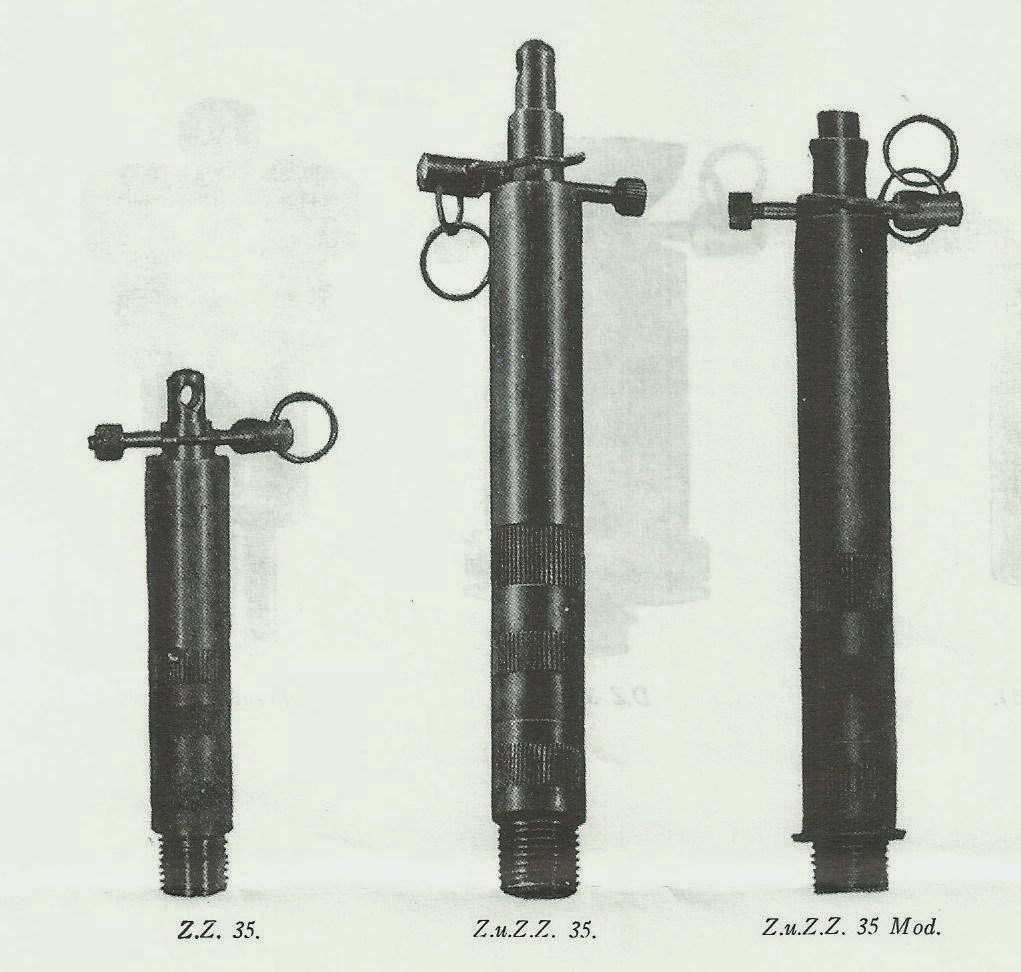
Two of the most common fuses for booby traps were the Z.Z. 35 (pull activation) and the Z.u.Z.Z. 35 (pull and release activation). These can be used in conjunction with egg grenades, S-Mines, teller mines, box mines, and stock mines.


Eihandgranaten 39 (Eihgr. 39)(Egg grenades)

The Eihandgranaten 39 is especially useful for booby traps. When the cap is unscrewed, a pull cord is revealed. Fasten a tripwire to this, or equip with a Z.Z. fuse. Blue capped grenades had a 4.5 second delay. The red caps, used specifically for bobby traps, had a 1 second delay. The types with “protective ears,” and a carrying ring, serve well as securing anchors when used as booby traps.
 
Illustrated Examples

Two teller mines connected by a Z.Z. fuse. Removing one will activate the other.
 

S-Mines were also very common for booby traps.


Teller mine equipped with two Z.Z. fuses.
 
 
Weight of Teller Mine keeping activation lever of grenade underneath in place.


Box mine. These were often pressure activated, but could also be set up with wires.
 
 
S-Mine with Z.Z. fuses.
 
 
S-Mine with pressure activated fuse.
 
 
Stock Mines with Z.Z. fuses.
 

Sources for info and photos:

Instruction Manual for the Infantry, H.Dv. 130/2a
Der Rekruit, 1935
Handbook on German Military Forces, TM-E 30-451, March 1945
World War II Axis Booby Traps and Sabotage Tactics, Gordon L. Rottman