Monday, February 9, 2015

Beyond the Blank Fire: A realistic approach to recreating life in WWII


     WWII reenacting has traditionally centered on public displays, which are ostensibly for educational purposes, and private combat simulations that are usually referred to as "tacticals." In tacticals, reenactors take to a make-believe battlefield, and blast away at each other with real or simulated weapons until the end of the event. Participants usually state that they take part in tacticals to get a feeling of, "this is what it may have been like." Unfortunately, as most any long-time reenactor will readily admit, there is simply no way to realistically recreate field combat in WWII. There are few, if any, tanks or aircraft, few heavy weapons, no artillery. Reenactment combat generally happens at, or near, hand-to-hand distances- not the ranges at which Wehrmacht strategists anticipated- which makes reenactment use of correct tactics difficult or impossible. Further, the realities of reenactment sites often necessitate attacking positions from directions that would not be feasible, or defending positions unsuitable for defense. Virtually no reenactment unit actually takes the field in Bataillon or even Kompanie strength -- independent units of 10-15 guys are typical at a reenactment battle. In the reality of war, it is possible to aim, and fire, at a target nearby and miss. Additionally, many soldiers likely were hit by unaimed shots fired from great distances. Blank-fire simulated combat is, on the whole, a very poor way to create a realistic representation of something that really happened.  Worse, "public tacticals," for educational purposes, are entirely unsuitable.

     In Sicherungs-Regiment 195 we strive to precisely recreate a historical place and time. This mandates an approach starkly different from reenacting as it has traditionally been understood. Firing a blank at a reenactor and feeling indignant when he does not "take a hit" is boring and puerile, and typically leads to disappointment, animosity, and hobby burnout. We seek a more realistic and immersive experience. Those of us who founded this unit are all "veterans" of the blank-fire "combat" scene. Whatever thrill or rush might once have been obtained from the bangs and flashes of a sham battle are long-gone. What remains, though, is a passion for historical recreation. Bringing the past to life through painstaking recreation of all details of an earlier era is truly central to reenacting; it is the crux of our hobby. That is what is important. The means of this recreation, or the choice of activity being recreated, are secondary things.

Spending a night in a foxhole, without firing a shot, is a very realistic experience. (505th RCT D CO) 
     
     Are there activities that can be recreated in a more authentic way, that can better give a true feeling of "this is what it may have been like?" Absolutely. There is no doubt that the lure of the tactical draws many people to our hobby. But, truth be told, paintball or airsoft, where real projectiles are flying through the air, may be a more realistic option for those who want the feel of hunting and being hunted -- to say nothing of the real military, which undoubtedly attracts many young people yearning for a taste of battle. It is our belief that focusing the WWII reenactment hobby on hoak battles does our hobby a disservice. Demographics are changing, most reenactors are no longer the sons of the WWII veterans. A more diverse hobby with a wider range of options for participants could be larger, and more inclusive, without any compromise on authenticity. It is no secret that many, or most, reenactors would not be considered fit for real front-line combat duty. Yet,  paradoxically, virtually all reenactment groups exclusively portray line infantry units. It is our hope that this will change, and we see ourselves as part of this change. 

 Partisan (Grenadier-Regiment 914)

     Even units portraying combat infantry formations need not be centered exclusively on blank-fire combat. Soldiers in every kind of unit deployed to an area of operations. There, they set up quarters, prepared and issued rations, performed drill, marched, had inspections... As the old saying goes, "War is hours of boredom punctuated by moments of sheer terror." A focus on battle reenactments means endlessly attempting to repeat those moments of terror, while avoiding all those hours of more typical, and often mundane experiences. Field soldiers constructed positions, manned observation posts and foxholes, performed scout/reconnaissance and security patrols, stood sentry duty, and ran messages to rear areas. All of these are things that can be realistically portrayed, with the men and means available to a reenactment group.

Patrols do not always have to end in engagement. Sometimes nothing is found. (Unknown unit)  

     We are a rear-area unit and we have no shortage of events that we can participate in while being true to our rear-area impression. Last week, a WWII German reenactor in Texas was shot at a battle when a GI reenactor began firing live rounds. That is a commitment to realism that we will not make. In other scenarios, we readily find the authenticity we seek, without any compromise. 

Roadside sentries (Sicherungs-Regiment 195) 

     We reject the notion that tactical battle reenactments are necessary for our hobby. Use of real weapons in an increasingly complex world of state firearm regulations and noise ordinances actually make reenactments more difficult. We embrace the idea of a hobby in which battle scenarios are just one type of private event, no more important than other events, which do not offer a "trigger time" option. We call for all reenactors to keep an open mind, and consider non-combat immersion events with varied scenarios. Our hobby can thrive even without blank-fire tactical if we choose to focus on the historical recreation, which is at the very heart of what we do. Last month, some of our members helped with a Wehrmacht headquarters clerk office vignette at the annual Battle of the Bulge event at Fort Indiantown Gap PA, the largest WWII event on the East Coast. We issued identification documents and passes to hundreds of event participants. The positive feedback on this functional recreation of a Wehrmacht office was overwhelming. While typewriters and fountain pens have a limited appeal, such a vignette could be incorporated as one part of any field immersion event, together with countless other realistic impressions that would not necessitate any opponent at all.


     We understand that tacticals will always be a part of the WWII reenactment hobby. However, we desire to serve as a constant reminder that, just as line infantry is only one of a myriad of possible portrayals, combat is just one of countless activities in wartime soldier’s life. These other countless activities can serve as the focus of an immersive and zoney event. 

Soldiers construct a network of noise makers/listening posts. (3.Panzergrenadier-Division) 

Friday, February 6, 2015

Insert pages for the Soldbuch

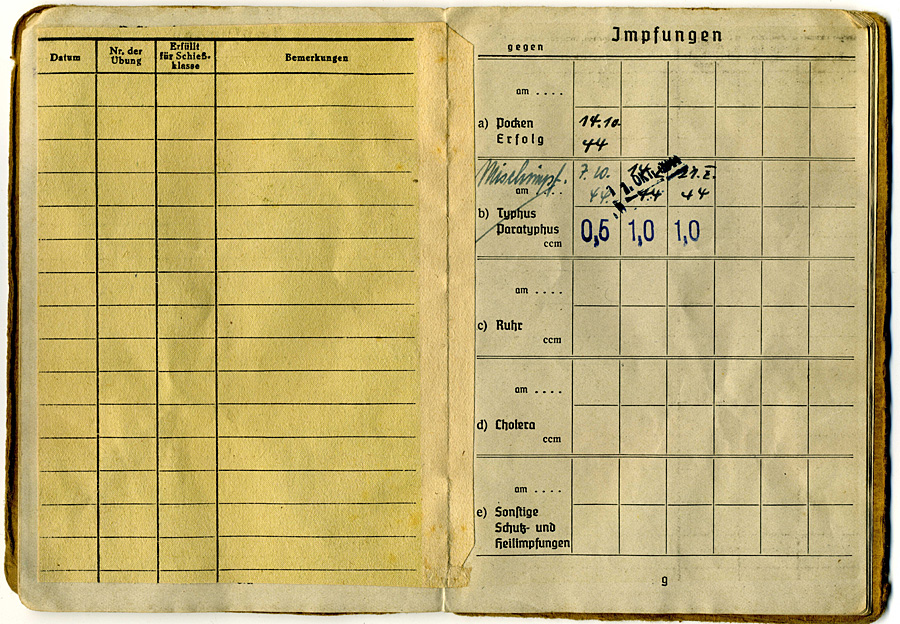
Every soldier in the Wehrmacht was issued a paybook and identification document called the Soldbuch. Original Soldbücher commonly had additional pages pasted in to record things for which the book had no space. Here are a few which we have reproduced and used.

EQUIPMENT ISSUE

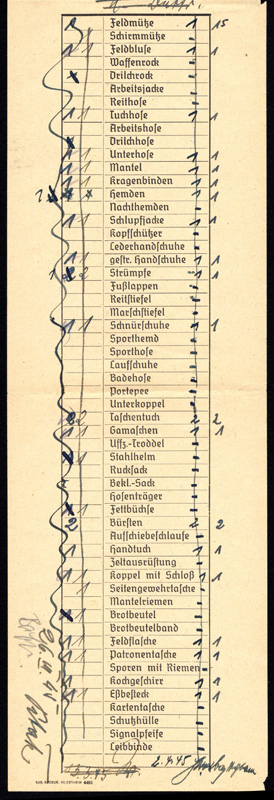
The first pattern of Soldbuch as made and issued in 1939 had a very limited amount of space on pages 6 and 7 to record the items a soldier was issued. The pre-printed item list omitted many basic items issued to nearly every soldier, such as ammunition pouches, clothing bags, or the Zeltbahn, and there was very little space provided to add these in, and no space for the many other items often recorded on these pages, such as Gamaschen or special clothing items. To fix this problem, later patterns of the Soldbuch had many more items pre-printed on these pages, along with more space to record items not present in the list. However, very many books were made and issued with the first batches in 1939, and stocks of these early books continued to be issued throughout the war. To update these books, and also to add more space in cases where these pages were filled with entries after years of service, a wide variety of inserts were made to be pasted into the Soldbuch. Some were fairly close copies of the equipment issue pages in later pattern books, others were more elaborate fold-out inserts. The equipment issues and checks were fairly frequent for many soldiers, these were conducted when a soldier was transferred, deployed to the field, or at various times when equipment reissues took place. In any Soldbuch that was carried for a few years by a soldier who saw field service, it is typical to find at least one of these inserts
 
 
This page would be pasted at the top onto the top of page 7 in the Soldbuch, then folded in the middle with the lower half folded up and over the upper half, to enable it to fit neatly in the book (you can see the crease from the fold on the line that says "Portepee" in the scan). This particular insert shown in the scan was issued in 1945 and was the last of multiple inserts pasted onto these pages of a Soldbuch issued in 1939. I have reproduced this insert and attached it as a PDF, it is sized to be printed on A4 paper as it is slightly more than 11 inches long. If you want to print it out but don't have A4 paper, you can get some larger sized sketch pad paper and trim it to size, 8.3" x 11.7".
 
SOAP RATION 
 
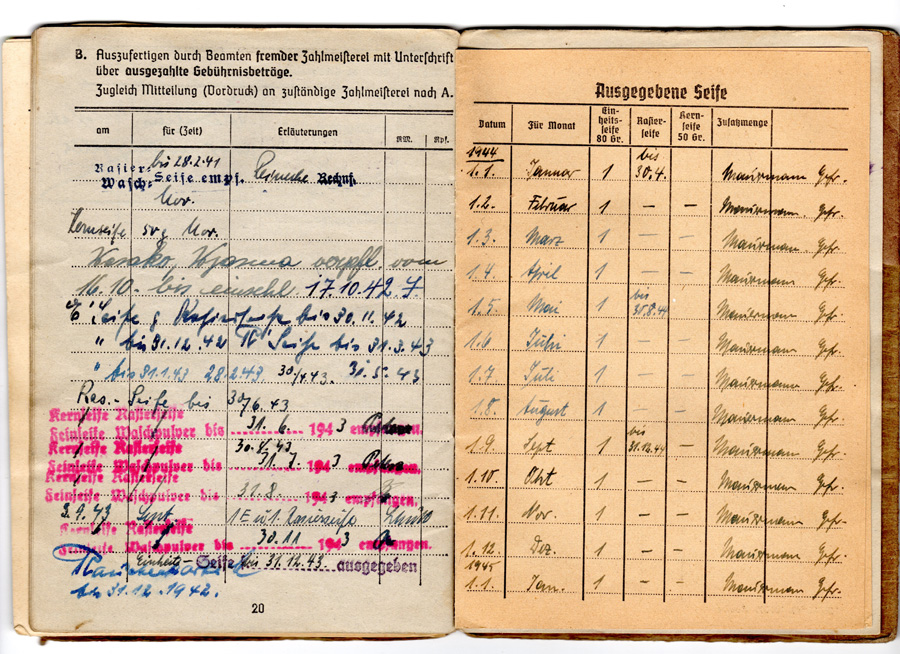
Soap was carefully rationed and controlled in WWII. It fell under the auspices of an authority called the "Reichsindustriestelle fuer Fettvrsorgung" that controlled soap production and supply. Soldiers in the field may not have been issued soap and if they were it may not have been recorded. But soldiers in the rear- in training, garrison troops, convalescents, etc.- were issued soap and very often these issues were recorded in the Soldbuch, either with a myriad of stamped or handwritten entries, or as here, with a special insert page. This particular soldier was serving as a POW camp guard in Germany during the time indicated on this soap issue insert. 


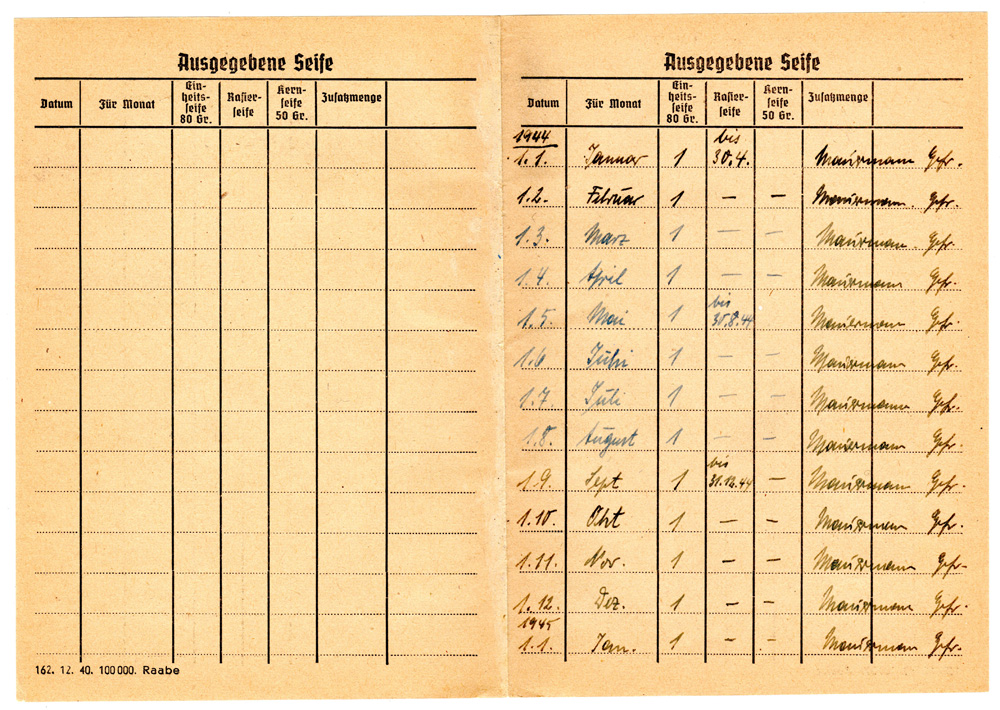
The insert is printed on both sides and folded in the middle to make four pages. It is loose in the book, it may have been glued in at one time. Only one of the four pages has entries. Both sides are exactly the same.
 
Soap ration insert PDF

To fill this out please refer to the scan of the original. The first column is the date of issue, the next column is to indicate the month for which the samp was issued. The next three columns are for different types of soap: "Einheitsseife" which was an all-purpose soap suitable for whatever purpose, shaving soap, and "Kernseife" which was a type of soap with no natural glycerin that could have been used for washing. The last column, "Zusatzmenge," was for recording additional soap issued. The last two columns are used here for the signature and rank of the soldier receiving the soap, in this case "Mauermann Gefr."

This insert can be used in any Soldbuch for any branch. One exception might be officers as presumably they had to buy their own soap. Virtually every soldier at one time or another was stationed in the rear even if only during recruit training. The original was printed on thin natural-colored paper.
 
SCHIESSLISTE

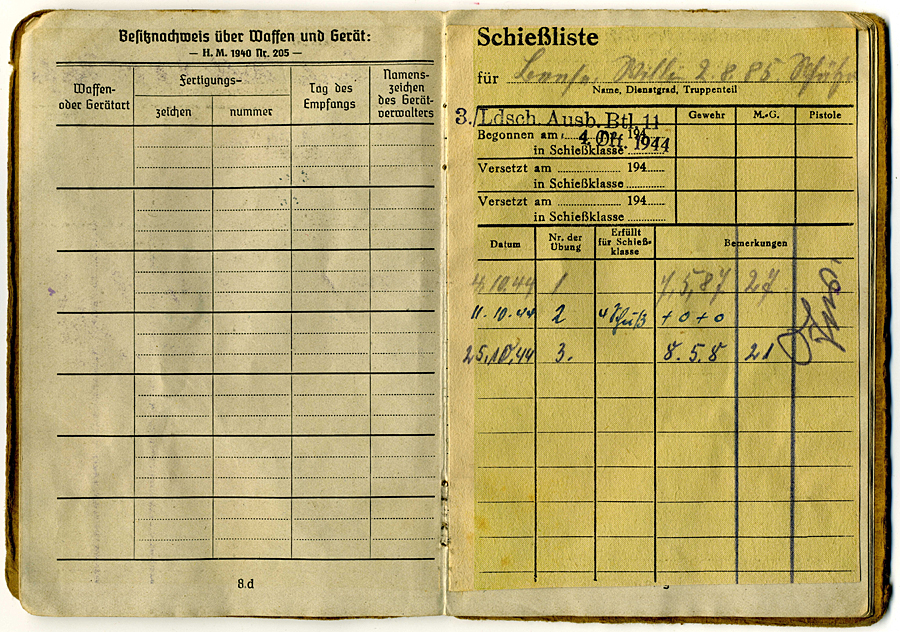
Since at least WWI if not earlier, marksmanship training was recorded in a document called the Schiessbuch. During the war, the Schiessbuch was at least partially supplanted by a number of inserts intended to be pasted in the Soldbuch.  


This example was printed on typical wartime paper and had a sort of green overprint that was probably intended to serve as an anti-counterfeit measure. The purpose of this insert was to record the "shooting class" of the soldier for each training session but as you can see, here, it was just used to record scores. We have reproduced this document, but without the green overprint.


Tuesday, February 3, 2015

Paperwork for a living history impression

Reenactors interested in the finer details of an impression often ask what would constitute an ideal set of paperwork for a first-person persona. The answer is always that the best paperwork that a reenactor can carry is paperwork that he understands and that he can relate to his portrayal. The Soldbuch is the crux of personal paperwork and knowing what is written in there and what everything means is a key step in a first person impression. The flap in the back of the Soldbuch is a good place to keep things like reproductions of period photos, most are small and fit in there easily. Anything that a reenactor can understand and explain and build a story around will be better to carry than even perfect reproduction paperwork if one doesn't know what it means or how it relates to the character being represented.

In the realities of war, there were an endless number of variables regarding what paperwork was carried. There were regulations, of course, but these regulations seem to have been more or less widely disregarded, and much of what was actually carried on a day-to-day basis seems to have depended heavily on such variables as personal preference, unit or type of unit, area of operations, etc. It seems like there were few hard and fast rules as to what was carried and what was not, what was retained and what was discarded. The Wehrpass was not supposed to have been carried by the individual soldier but some soldiers went into captivity carrying these so this must have happened at some times, for some reasons.  Having said all that, here are our conclusions based on studies of more-or-less untouched paperwork groupings. Others may have come to different conclusions.
SOLDBUCH: As stated, this was the basic individual ID and is the cornerstone of personal paperwork from a reenactment perspective. Some soldiers were issued Merkblätter which were small leaflets about topics including gas warfare and various ailments, these leaflets were supposed to have been glued into the Soldbuch but the majority of original Soldbücher, including many books issued early on and carried throughout the war on all fronts, do not have these (even when other various documents are still associated with the Soldbuch) and so their issue was either rather limited or the mandate to keep these in the Soldbuch was widely ignored.

OTHER ID DOCUMENTS: Soldiers were issued many different kinds of lesser ID documents which were issued right down to Kompanie level in some cases. This category can include things as simple as small signed and stamped paper scraps attesting that the soldier belonged to a particular unit, as well as various kinds of photo IDs such as the military driver's license or the Dienstausweis, and all kinds of passes and permits.
TRAVEL DOCUMENTS: Soldiers do seem to have retained various kinds of travel documents such as the Dienstreiseausweis or the Wehrmachtfahrschein even when the travel was completed, for whatever reason. There were also documents that permitted soldiers more or less free travel in specific areas for specific purposes, these also seem to have been retained. There were also passes to enter certain cities, some of these were valid only for a specific occasion, others were valid for longer periods.

AWARD DOCUMENTS: Some have stated that award documents were to be kept in the Soldbuch. Based on our studies, we do not believe that award documents were carried in the Soldbuch most of the time. No doubt they were carried in the field for a period immediately after issue, but the official entries in the Soldbuch would seem to make carrying the associated documents redundant.

LETTERS FROM HOME: Regulations stipulated that letters from home were not to be carried in the field to deny the enemy any intelligence contained therein. In reality, soldiers did keep and carry these, sometimes accumulating large numbers of them when circumstances permitted. Feldpost was second only to ammunition in the supply system, and getting mail from home was an important feature of the life of the Landser.
PERSONAL STUFF: By this, we mean really personal. Many soldiers carried small booklets in which they would record addresses or keep records of mail sent and received. Some soldiers kept journals in these small notebooks. They seem to have been very common. Photos of loved ones were also carried by very many soldiers.

EPHEMERA: We find lots of stuff in paperwork groupings that were intended to be discarded but that were kept for whatever reason. A page from a calendar, a little piece of newspaper, a blank form or a receipt for hay or for cabbage, perhaps these were used as bookmarks, perhaps they had some personal significance known only to the soldier, or maybe it was just pocket trash. Some companies would even send advertisements in various forms to soldiers at the front and sometimes the recipients would hold on to these.

CIVILIAN STUFF: Many soldiers seemed to have carried documents related to their civilian lives, even when these documents would seem to have been useless at the front. Insurance cards, post office box receipts, paperwork regarding bank accounts, or similar stuff.

The paperwork that you can carry is limited only by your imagination. We have held many untouched paperwork groupings as carried by German soldiers and have never found one loaded with Reichsmarks and porn as carried by so many reenactors. It is far more common to find a couple of plain-looking pictures, a local provisional ID or travel permit, perhaps a letter from home or a certificate relating to the soldier's civilian life, and a scrap of paper with seemingly random notes, their significance lost to time.

Monday, January 19, 2015

Blank stationery for Feldpost military mail

     The link between German soldiers serving in the Wehrmacht and loved ones at home during the war years was the military mail system, Feldpost. Feldpost was regarded as crucial for morale and in Wehrmacht supply lines, it was regarded as a higher priority than any form of supply with the exception of ammunition. Many millions of letters were sent through the Feldpost system during the war. Writing and sending letters and receiving news from home through the mail was an experience common to virtually every Landser.
     An immeasurably vast array of paper and envelopes were used for Feldpost during the war. By 1944 paper was often in short supply and old envelopes were being turned inside out for reuse. Stationery from occupied countries like France and Italy was used, in all sizes and colors. Most envelopes were made from a rough natural-colored paper, brown and blue paper was also common. Soldiers were issued or could buy plain paper and envelopes and also pre-printed letters and cards formatted for Feldpost mailing. We have reproduced a number of these, below are links where these can be downloaded in PDF format, ready to print.
     These first two are simple postcards. They were printed on one side only, the address side. The other side was blank and would be used for the message. These were printed on thin, flimsy card stock that was easily creased.


     Here are 3 folding letters. These were generally gummed around the edges so they could be sealed, like the flap of an envelope. This first one was printed on thin, light brown paper.


     This one was printed on thin gray paper. The area that was gummed was marked on the front, to open the letter the recipient could trim off the gummed part.


     This last one was probably a type that soldiers had to purchase. There is a motivational quote from the author Ernst Jünger on the back: "Courage is the living fire that armies weld." It was printed on better paper than the others, smooth, with a slight blue tint.


     Of course, printing out the blank stationery is the easy part of having realistic mail for living history. Filling out the letters is more of a challenge. To help with this, here is a quick guide on how the addresses were written on Feldpost letters. The images are scans of letters in a member's collection. Firstly, some letters written from home to soldiers.

     These letters were sent to soldiers by other soldiers serving in different units.

     Here are some letters home, written by soldiers. Note that in the addresses, the town or city name is the second line in the address, the street address is the third line- the reverse of the way this is done today.


     People in the 1940s wrote with fountain pens or with simple dip pens. Ink was in short supply and people used what was available, mostly black, blue or blue-black, sometimes watered down to save ink. For soldiers in the field, the most common writing instrument was probably a simple pencil.

Sunday, January 11, 2015

What color were Heer wool uniforms?

     Wool uniforms issued to most soldiers in the wartime German army were to be made of "Feldgrau"-colored wool uniform cloth. The actual range of fabric color used for wool uniform fabric was vast. Early in the war, bluish-green predominated for field blouses. As the war progressed, this color shifted to grayish-green, to greenish-gray and eventually to brown. But there was always a lot of variation in these shades and there were countless exceptions to these generalities. Blue and steel-gray Italian fabrics were also widely used after 1943.
     Below is a photograph of uniform jackets from a member's collection. With the exception of the tailor-made NCO field blouse at top left and the officer service blouse directly below it, all of these are issue uniforms.

Tuesday, January 6, 2015

Reproduction uniforms and artificial aging

Several years ago at the annual Battle of the Bulge reenactment at Fort Indiantown Gap, Pennsylvania, I was perusing the wares in the SM Wholesale vendor building. They had a pile of Luftwaffe Fliegerblusen, well-made with quality materials, but obviously new-made reproduction items for reenacting. Next to this pile was a single very different-looking jacket, made of a different-looking wool, showing wear and use. I collect original uniforms and immediately recognized the typical appearance of a worn original garment, I surmised that this was the original that the vendor had used to pattern his copies and that he was showing it off for comparative purposes. I approached the vendor and asked him if he would be willing to sell that jacket and was shocked when he told me that it was one of his copies, no different from any of the others on the table, only cleverly aged. I was stunned, the wool fabric looked totally different, it really looked original. He was happy to talk about his tricks, he had burned all the nap off with a torch, scraped off the singed fibers, soaked it in water and then froze it solid, thawed it and repeated, and sprayed it with a fine spray of tea, among other similar tricks. It had shifted the color to a muted tone, the wool weave had a coarse appearance, and the fabric had lost all structure, it was as supple as a dishrag. As soon as I got home I started working on my own reproduction uniform and I was amazed at the transformation. Immediately I had people approaching me asking if my jacket was original. The best accolade came a year later, back in the SM Wholesale vendor building again. That same guy didn't recognize me when I stepped through the door but he immediately approached and asked, "Hey, is that an original tunic?" I was pleased to be able to tell him that it was his formula that I had used to make my copy jacket look like the real deal.


 Most reenactors have only limited experience with original garments. It is possible for a reenactor to become very skilled; to amass a vast amount of knowledge about his impression, unit history and the course of the war; to interview numerous veterans; and to learn a great deal of period terminology and tactics; and yet never see the lining of an original jacket in person. To put it another way, most reenactors really cannot discern a perfect copy from something with poor details. 15 years ago, the reenacting unit I was a member of would allow reproduction uniforms from any vendor, and this was never a problem. We only had to enact strict standards about approved vendors years later when the first Chinese-made stuff first appeared- it was abysmal. Many reenactors today may never have seen what this stuff looked like when the first runs appeared being sold by Hong Kong Keith and others. Flimsy bright green shirt-weight wool/poly blends, square patch pockets, huge shapeless sleeves, plastic buttons, no details. This stuff I would judge to be barely even useable for a Halloween costume or film prop. Unfortunately there were many people buying this rubbish, probably they simply did not know better. At that time we mandated that recruits could only buy uniforms from one approved vendor. This policy was the only way we could steer people away from the ever-changing cast of characters peddling these wares on eBay and elsewhere, and it worked good, up until the approved vendor closed his doors taking many customers' money with him. At that time we were forced to take a hard second look at the cheaper imported products sold by many vendors. What we saw was a huge improvement from the first runs of these garments. It was no longer possible for me personally to justify telling a high school student to pay more than $300 for a tunic when one for $95 was more than percent there.
If it is in your budget to pay more than $500 for a custom-made jacket, go for it. They are the best out there and there is a perceptible difference. But is it worth the extra cost? It depends on your budget and the value of a dollar to you. To me... I'm not sure it is worth it. If you can't afford $500, don't sweat it. Get a basic jacket that fits you and treat it rough so it gets some honest wear and use. Get it wet, get it dusty, let it bake in the sun. Take the $400 you saved and put part of it towards some German language CDs or take a course. Seeing a guy in an imported reproduction jacket does not ruin my event. I would rather be in a unit of fat old guys wearing Chinese-made stuff who understand period culture, have an appreciation for the history, speak some German, can explain the entries in their Soldbuch, and are willing to sleep on the ground, than a unit of skinny younger guys in head-to-toe high-end reproduction kit but whose only exposure to WWII is video games and who talk like modern Army dudes in the field. Get the best you can afford, but at the same time, understand that there is so much more to an impression than a uniform. And no reproduction is perfect.

Friday, December 26, 2014

Sicherungs-Regiment 195 Year in Review 2014

2014 was the first year of our reenactment group. With the year ending, we want to reflect on our progress and also to share our best photos from this year of reenacting.

 This unit was started by experienced reenactors looking to try something new. To our knowledge, there never had been a reenactment group that portrayed security troops. Dissatisfaction with the lack of authenticity inherent in mock battles led us to something more cerebral than a grown-up’s version of Cowboys and Indians. It was important to be a field-based impression; an impression with a second-line focus, less oriented toward combat, and more toward basic camp and field life. We settled on a Sicherung unit after discussing many options.
At first, the learning curve was steep. We began research to forge this new impression. Initially, only a few sources yielded information. From the very start, however, the information discovered strongly validated our impression choice. We had not realized how thinly spread Sicherung units were. Sparsely-manned outposts were used to garrison vast swathes of countryside in the rear areas of the various Army groups. This historical reality meshes perfectly with our small unit model. From this, we devised a standard model of an "outpost"-based scenario for field deployment.
Selecting the exact unit to portray was also a challenge. We quickly identified a number of Sicherung units with interesting histories. Sicherungs-Regiment 195, however, was an obvious final choice. Elements of unit were actually deployed both in the West and in the East simultaneously. From a reenactment perspective, we were very pleased to choose a unit impression that offers such vast versatility.
Our first event was an immersion/training scenario. More than anything else, this event served as a test of our new concept and approach to the hobby. We were the only people on the site, there was no need for an "enemy" to fight against. All of our members attended and it was a total success. We planned and prepared for the event, then deployed to a farm where we conducted patrols, searched for partisans, did some training on language and tactics, prepared rations, and cleaned our rifles. Everything went just as we hoped, and we all enjoyed some incredibly realistic experiences. The lessons learned from this event paid dividends throughout the year.


With initial training complete, we were ready to deploy to the field at a regular tactical. When the combat troops moved out, we moved into the rear to perform observation and security details. Rifle fire echoed in the distance while we guarded a road and set up observation positions. Again, the end result was an incredibly realistic-feeling experience. We had proven the value of our concept and it was very gratifying.


As the year wore on, we made some changes to reflect new information about the historical reality of how Sicherung troops were equipped. Many of our existing late-war uniform and equipment items were replaced with mid-war equivalents. This served to reflect the low supply priority of under-equipped rear-area troops, who were unlikely to have been issued the newest equipment. German K98 rifles were replaced, in part, with Czech VZ24s. Members also obtained a mix of paramilitary-type, and obsolete, gear as we dialed in to our new impression. 

The unexpected discovery of an original Soldbuch from Sicherungs-Regiment 195 provided very encouraging validation. The soldier was issued a captured foreign rifle and bayonet. He was also issued a Tornister and a HBT uniform, both items we had decided to include in our portrayal. All of this fit perfectly with what we learned about the wide variety of weapons and equipment that these troops were issued. Further research led to some additional primary sources, which were very helpful. We now have an ever-growing body of documentation to work with, as we settle into our impression.


The response from others in the WWII reenactment community has been overwhelmingly positive. We have received positive feedback from all over the world. We also had the opportunity to take to the field with our like-minded friends in 3. Panzergrenadier-Division, and the Finnish JR7 unit (which debuted this year). We attended new events that none of our members had ever participated in before. In the process, we had a lot of fun, and made a some new friends. At some of 2014’s events, we were the largest attending German unit. We are proud to support local events, and especially Eastern Front scenarios. We continue to share information via this blog, Facebook, and on our web site (upgrade coming soon).

Things look bright as we head into 2015. Our year will begin in February with our annual planning meeting. We expect another busy and successful season.